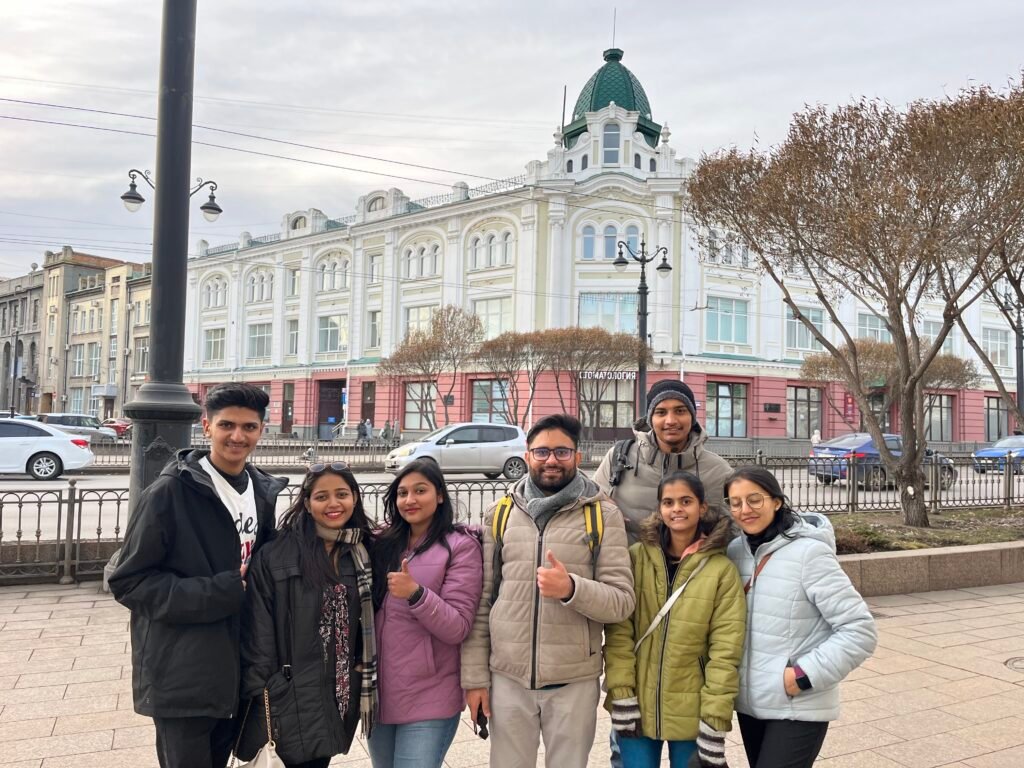
I studied MBBS in Russia myself — Graduated from Altai State Medical University — cleared the FMGE, and have spent the last ten years guiding Indian students through this exact decision. So let me give you both things on this question: the straight figures first, and then the honest truth that most articles leave out.
The straight answer: the NEET marks you actually need
To study MBBS in Russia, an Indian student only needs to secure the minimum NEET qualifying marks. That’s the 50th percentile for the General category and the 40th percentile for reserved categories.
“Percentile” confuses people, so here are the actual mark ranges. They shift slightly every year depending on the NTA cut-offs, but they typically fall here:
- General / UR category: around 150–170+ marks
- OBC / SC / ST category: around 120–140 marks
For 2026, my expected range is roughly 140–150 marks for General and 115–120 for the reserved categories. Treat these as a guide, not a guarantee — the official cut-off is announced fresh each year.
But here’s what NEET actually gates, and most people miss it
This is the part you have to understand clearly. Qualifying NEET is a requirement of the Indian government for Indian students who go abroad for MBBS and want to come back and practise as doctors in India.
Technically, a student can go and study MBBS in Russia, or anywhere abroad, without qualifying NEET. But then they won’t be able to return to India and get a license to practise here. That’s the trade-off nobody spells out.
On the admission side, most universities abroad ask Indian students to submit their NEET score, and some still accept Indian students without it. But the NEET requirement isn’t really about the university — it’s about your future right to practise in India.
Does your NEET score predict how you’ll do? Honestly, no
I’ll tell you something that goes against what most people assume. In my experience, the NEET score does not matter at all in predicting how a student actually does, and especially whether they clear the FMGE at the end.
I’ve seen students with very low NEET scores clear the FMGE in their first attempt. And I’ve seen students with high NEET scores need a few attempts. And the other way around too. The number on your scorecard simply isn’t the thing that decides it.
What decides it is something the marks can’t show: how consistent and disciplined you are once you’re actually there.
Two students, two scores, two outcomes
Let me prove this with two of my own students. No names, just the scores and what happened.
The 450 who needed two attempts
This student’s NEET score was around 450 — a good score. He took admission in a university in Russia through us. But during his university years he lost much of his interest in studies and wasn’t consistent with his classes. After graduating he came back, gave the FMGE, even took physical coaching — but there too he wasn’t consistent. He failed his first attempt by around 40 marks. To his credit, he then got his act together for the second attempt and cleared it.
The 185 who cleared first attempt
This student’s NEET score was just 185 — right around the qualifying line. He went to Russia through us as well, and he was fairly consistent with his studies throughout. He came back, cleared the FMGE in his very first attempt, and is now going to give NEET PG after finishing his internship.
Look at the two side by side. The 450 had more than double the marks of the 185 — and it didn’t help him. The consistency did. That’s the whole point.
What else you actually need, beyond NEET
NEET isn’t the only box to tick, so let me cover the rest honestly.
In Class 12, most universities want at least 50% in PCB — Physics, Chemistry and Biology — and some ask for more. Universities in Russia also conduct their own entrance test; we prepare our students for it and make sure they clear it, so that part never catches anyone off guard. The age requirement is largely the same as NEET, a minimum of 17, though some universities have an upper age limit of around 24 to 25 years.
And to answer the “Russia versus other countries” question directly: this is broadly the same for almost all destinations, not just Russia. The NEET rule especially is an India-side requirement, so it applies wherever you go.
“My marks are low but qualifying. Am I just not good enough?”
Dekho — if you’ve scored low but you’ve qualified, and you’re scared it means you’re not good enough for medicine, don’t think like that.
The competition in India is simply too much. The number of students sitting the exam is enormous compared to the seats available, and the odds are often stacked against the student. We’ve all seen how unfair the system can get — the whole NEET paper-leak controversy is one example of that. A lower score does not mean you aren’t cut out to be a doctor. I’ve watched students who scored low come back, clear the FMGE in their first attempt, and go on to work as doctors and prepare for NEET PG. The scorecard didn’t define them.
“I didn’t qualify NEET at all. What now?”
If you didn’t qualify, the first thing to do is be honest with yourself about why. Ask:
- Did I genuinely not study enough?
- Were there distractions that pulled me away?
- Did I really study hard and still fall short?
- Was it bad timing, or a health issue right before the exam?
If there was a genuine external reason, and medicine is truly your life’s goal, and your plan isn’t to come back to India to practise — then yes, you can still consider going abroad. But for most students, my honest advice is to qualify the exam first, because it’s always good to keep India open as an option.
And one warning. A lot of consultants will try to sell you the idea that you can skip NEET, go abroad, and simply clear some other country’s licensing exam — the USMLE for the US, PLAB for the UK, and so on. It is not that easy. If you couldn’t qualify NEET, you have to think very seriously, because the USMLE and PLAB are not easy exams. Assuming you’ll clear a harder exam after struggling with NEET is not a realistic plan.
So what actually matters?
If you’re fixated on this one question — how many marks do I need — here’s what I’ll leave you with. The qualifying marks are just one thing to clear. Beyond that, the single most important factor is being realistic and consistent with your studies after you go for MBBS in Russia or abroad. That is what actually decides whether you become a practising doctor.
Qualifying NEET is not the main thing. Staying consistent through the six years of the course is.
If you want an honest read on your situation
I won’t tell you everything is easy. What I will do is give you the hard truths first — and then my team handles your admission and your entrance-test preparation properly, so you don’t fall into the traps that cost other families lakhs.
And remember, admission is only step one of becoming a doctor. The real work is yours, all the way to the FMGE and beyond.
If you want me to look at your specific case, message us on WhatsApp with your NEET score and we’ll tell you honestly which Russian universities are realistic for you — no false promises.
You can reach us on WhatsApp at +91 88261 31593.